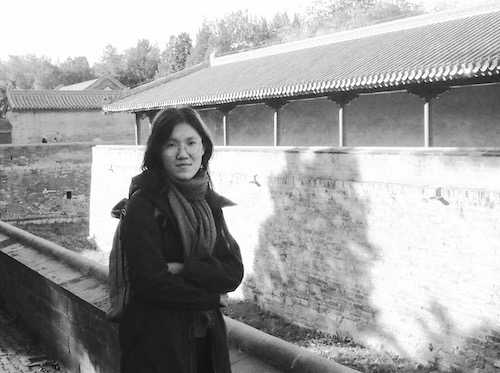
Qingyang HUANG
Doctorante contractuelle (ED 472)
Biographie
Diplômée de l’Université de Pékin, j’ai obtenu une licence en philosophie (2020) et un master en études religieuses (2023) avec un mémoire de Master intitulé « mKhas grub rje sur la définition de pramāṇa dans Yid kyi mun sel ». En effet, mon apprentissage des langues classiques et mes études sur la philosophie bouddhiste ont éveillé mon intérêt pour l’épistémologie bouddhiste indo-tibétaine, sur laquelle je mène actuellement mes recherches doctorales sous la codirection de Vincent Eltschinger et Isabelle Ratié.
PhD Project Late Indian Buddhist philosophers’ views on perceptual errors
Abstract
This project examines the theories of perception and perceptual error advanced by Dharmakīrti (ca. 600–660) and Prajñākaragupta (8th–9th century), investigating their perspectives and their critiques of Brahmanical scholars (primarily the Naiyāyikas and the Mīmāṃsakas) on these matters. It comprises two main sections: a philological segment and a historical-philosophical one. The philological part presents critical editions and annotated English translations of relevant sections from Dharmakīrti’s Pramāṇavārttika (Commentary on the means of valid cognition, PV) and from Prajñākaragupta’s Pramāṇavārttikālaṅkāra (Ornament of the PV, PVA).
Building on this textual groundwork, I plan a five-chapter introduction in my dissertation to provide a broader historical and philosophical context for the philological part. In the first two chapters, I intend to provide general overviews of Classical Indian perspectives on perception and errors. Regarding error theories in non-Buddhist traditions, I will focus specifically on how different Mīmāṃsaka scholars diverge in their interpretations of errors, reflecting their different approaches to grounding such experiences in the external world and to meeting their epistemological and apologetical considerations. In the third and fourth chapters, I will first present the evolution of the typology of pseudo-perception within the Buddhist logical-epistemological school and explain how conceptualization has consistently been identified as the core factor leading to error in that lineage. Thereafter, I will focus on debates between Buddhists and non-Buddhist scholars about whether our perceptual judgments of everyday objects are erroneous, given that conceptualization is necessarily involved. In the third chapter, I will address this issue through their debates about the existence and perceptibility of substantial entities in general; in the fourth chapter, I will address their debates as reflected in their disagreement over a recurring question in Indian epistemology: whether our different sense organs — particularly the visual and tactile — can engage with the same object. In the final chapter, I will explore the development of non-conceptual pseudo-perception and the definition of perception within the lineage of the Buddhist logical-epistemological school, with a detailed analysis of Prajñākaragupta’s approach to this issue, and his critiques of the non-Buddhist definitions of perception.