
How to express the way to liberation: a preliminary study in an unedited Persian translation of
the Laghu-Yogavāsiṣṭha made at Akbar’s court
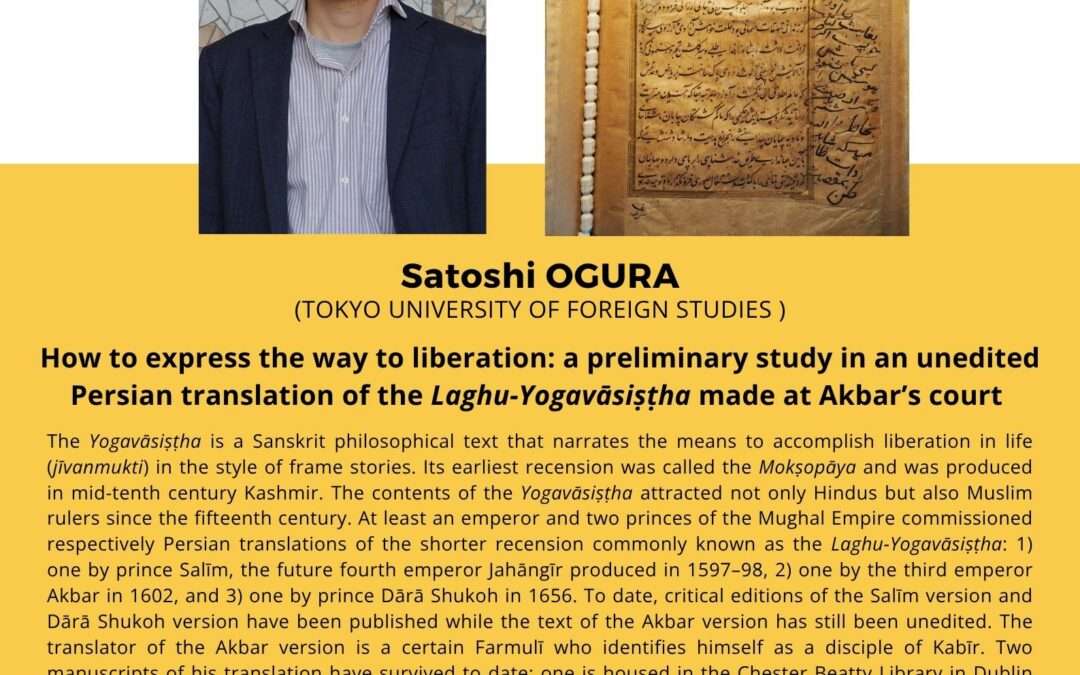
The Yogavāsiṣṭha is a Sanskrit philosophical text that narrates the means to accomplish liberation in life (jīvanmukti) in the style of frame stories. Its earliest recension was called the Mokṣopāya and was produced in mid-tenth century Kashmir. The contents of the Yogavāsiṣṭha attracted not only Hindus but also Muslim rulers since the fifteenth century. At least an emperor and two princes of the Mughal Empire commissioned respectively Persian translations of the shorter recension commonly known as the Laghu-Yogavāsiṣṭha: 1) one by prince Salīm, the future fourth emperor Jahāngīr produced in 1597–98, 2) one by the third emperor Akbar in 1602, and 3) one by prince Dārā Shukoh in 1656. To date, critical editions of the Salīm version and Dārā Shukoh version have been published while the text of the Akbar version has still been unedited. The translator of the Akbar version is a certain Farmulī who identifies himself as a disciple of Kabīr. Two manuscripts of his translation have survived to date: one is housed in the Chester Beatty Library in Dublin and another is in the Punjab Public Library in Lahore. In translating the Laghu-Yogavāsiṣṭha under the commission of Akbar, Farmulī knew the preceding translation, i.e., the Salīm version which was translated by Niẓām al-Dīn Pānīpatī, Pathān Miśra Jājīpurī, and Jagannātha Miśra Banārasī. Nevertheless, Farmulī employed a different translation strategy from that of the Salīm version at several points. One remarkable point is how to translate the concept of Brahman in the context of the target language. Salīm’s translation team on the one hand equated Brahman with the Absolute Existence (wujūd muṭlaq) in the doctrine of Ibn ‘Arabī’s Oneness of Existence (waḥdat al-wujūd). Farmulī on the other hand regarded Brahman as the fundamental principle conceived just by Vedāntins, not universal, and located it as the Unifying One (wāḥid), the state of being still externally one, but containing plural aspects within it. In this talk, I shed light on the Akbar version by Farmulī and demonstrate the feature of the surviving manuscripts, the textual characters, and its philosophical difference from the Salīm version.
- Organisateurs : Émilie Aussant (USN) et Vincent Eltschinger (EPHE-PSL)
- Invité : Satoshi Ogura (Tokyo University of Foreign Studies)
- Date et horaire : Mercredi 27 mai 2026 de 11h à 13h
- Lieu et salle : FMSH, 54 boulevard Raspail 75006 Paris, salle 9